NeuraListen™ auditory processing and listening program
Clinician guide for referrals to NeuraListen™
This page is for referring clinicians, including neuropsychologists, speech-language pathologists, physicians, educators, and related professionals. It outlines when NeuraListen may be clinically appropriate, what the program involves, and what to expect when you refer a patient or student.
NeuraListen is delivered by Anywhere Audiology® as a structured auditory processing and listening program. It is designed to complement, not replace, your ongoing care.
Looking for information to share with patients? View the patient overview here.
At-a-glance fit
Children, adolescents, and adults with suspected auditory processing difficulties
Patients who hear "normally" on standard audiograms but struggle to understand in real-world settings
Individuals with listening fatigue, slow auditory processing, or difficulty following rapid or complex speech
Patients already engaged in neuropsychological, SLP, educational, or mental health care where listening is a barrier
The clinical gap NeuraListen addresses
When hearing is "normal" but listening is effortful
Many patients report significant listening difficulties despite audiograms within normal limits. They may pass basic hearing screens yet struggle to process speech in noise, follow multi-step instructions, or keep up with rapid classroom or workplace communication.
These listening challenges can overlap with, mimic, or compound attention, language, learning, and mental health concerns. Without a structured way to evaluate and support auditory processing, these patients may be told that "hearing is fine" and are left without a clear treatment path.
NeuraListen is intended for this gap: patients whose primary concern is how they process, organize, and act on what they hear in everyday environments.
Typical clinical questions
Is this primarily an auditory processing issue, or better explained by attention, language, or anxiety?
How much of the functional impact is related to listening versus other cognitive domains?
Would targeted auditory processing work be a useful adjunct to existing therapies or educational supports?
What can we reasonably expect from a structured listening program, and how will progress be tracked?
NeuraListen is structured to work alongside your existing diagnostic impressions and treatment plans, with clear communication back to you after the evaluation and throughout the program.
When a referral to NeuraListen may be appropriate
Clinical patterns that often prompt referral
The list below is not exhaustive. It is intended as a practical guide for when NeuraListen may be a useful adjunct to your care. Clinical judgment remains primary.
Children and adolescents
- Appears to "tune out" or miss details, especially in noise
- Needs frequent repetition or rephrasing of instructions
- Difficulty following multi-step verbal directions
- Struggles more with oral than written information
- Listening fatigue by midday or after school
Adults and older adults
- Normal or near-normal audiogram, but ongoing difficulty understanding speech
- Reports that "speech sounds fast" or "words blur together"
- Marked difficulty in group conversations or meetings
- Needs to work hard to keep up with verbal information at work or home
- Listening-related fatigue that affects daily functioning
In the context of other care
- Neuropsychological profiles showing relative auditory weaknesses
- SLP treatment where listening is a limiting factor for progress
- Educational plans (IEP/504) where classroom listening is a primary barrier
- Mental health care where sensory overload or listening strain contributes to distress
- Complex presentations where clarifying the auditory contribution would guide your plan
Program overview
What NeuraListen involves for your patients
NeuraListen is a structured auditory processing and listening program delivered by audiologists with specific training in auditory processing and listening disorders. It is designed to be predictable for patients and transparent for referring clinicians.
Initial intake focused on listening history, functional impact, and co-occurring conditions
Targeted auditory processing evaluation, including speech-in-noise and related measures as indicated
Clear explanation to the patient (and family when appropriate) about findings and options
Individualized listening program plan with a defined duration and schedule
Regular check-ins to adjust difficulty and support adherence
Summary back to the referring clinician with key findings and program focus
How it complements your work
NeuraListen is not positioned as a stand-alone solution for complex neurodevelopmental or psychiatric presentations. Instead, it is intended as one component that focuses specifically on auditory processing and real-world listening demands.
Whenever possible, we align program goals with your existing treatment or educational plan and encourage ongoing coordination, especially for shared patients with multiple providers.
If you would like the program to address specific listening situations (for example, classroom lectures, team meetings, or therapy sessions), you can note this in your referral or contact us directly.
Walkthrough for clinicians
Overview of the NeuraListen pathway
This brief video walks through the typical NeuraListen journey, from referral to follow-up. It is intended as a practical orientation so you know exactly what your patients will experience.
If you prefer written information, the key points from the recording are summarized in the sections on this page.
Clinical foundation
How NeuraListen maintains clinical standards
NeuraListen is built and delivered by audiologists with experience in auditory processing, diagnostics, and patient counseling. The program structure is aligned with current best practices in managing listening and auditory processing concerns while recognizing the limits of available evidence.
We are careful to describe the program in realistic terms to patients and families, avoid overpromising, and emphasize that NeuraListen is one component of care, not a replacement for your ongoing clinical management.
Clinical guardrails
Clear documentation of indications, limitations, and scope of the program
Attention to co-occurring conditions and when additional referral is more appropriate
Use of structured intake forms to understand context, strengths, and supports
Monitoring for signs that the program is not a good fit, with transparent communication to patients and clinicians
Written summaries to referring clinicians that are concise and clinically oriented
If you have questions about how NeuraListen aligns with specific guidelines or practice standards in your field, you are welcome to contact us to discuss individual cases or general approach.
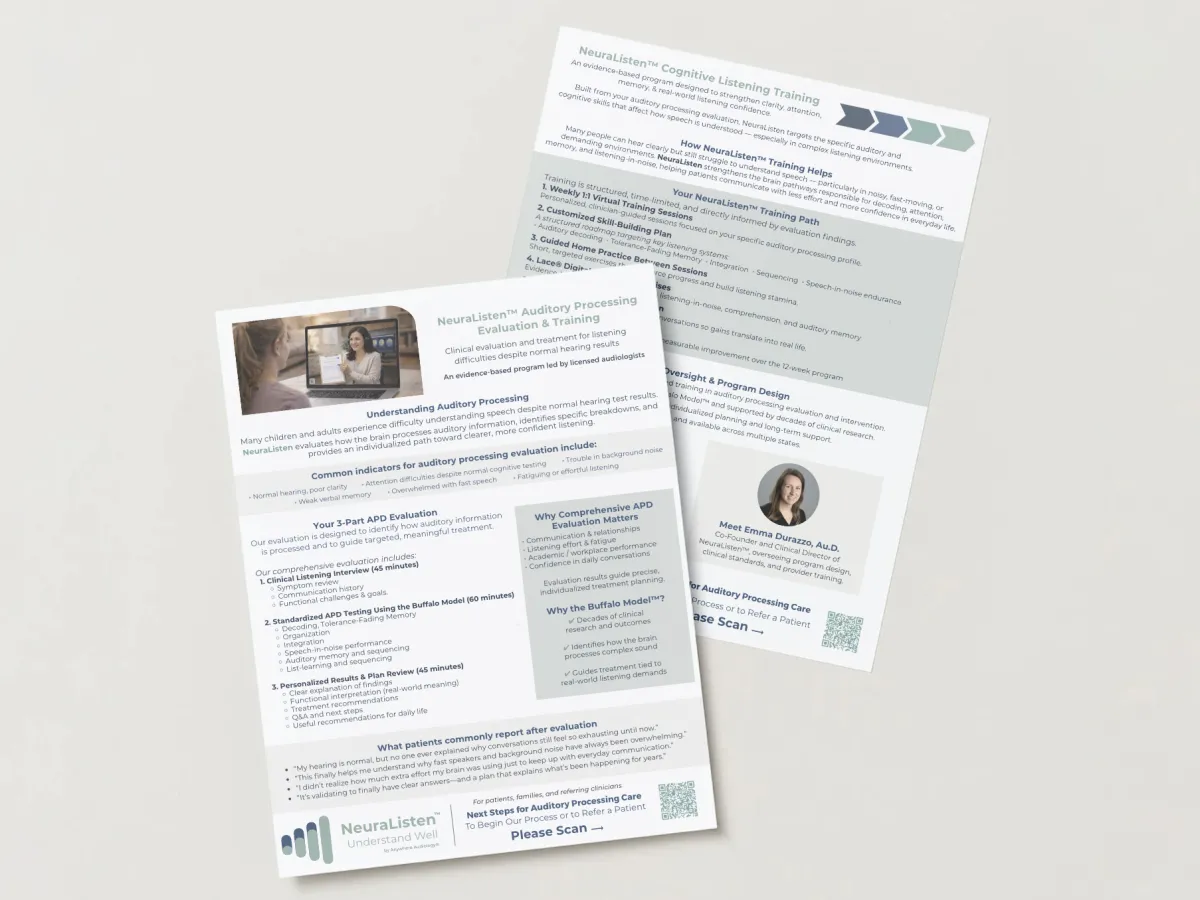
NeuraListen™Auditory Processing Evaluation & Training Overview
A referral-ready clinical overview designed to support patient education and streamline next steps.
After you make a referral
What you and your patient can expect
1. Referral and triage
Once we receive your referral, our team reviews the information you provide, including key concerns and relevant diagnoses. If needed, we may contact you for clarification before scheduling.
2. Evaluation and discussion
Patients complete an intake and, where appropriate, an auditory processing evaluation. We discuss results with the patient in clear language and outline whether NeuraListen is likely to be helpful given their goals and overall clinical picture.
3. Program, monitoring, and follow-up
If the patient proceeds, they complete the NeuraListen program with ongoing monitoring. At key points, and at program completion, we share a concise summary with you, including patient-reported changes and any recommendations related to listening that may inform your care.
Referral pathway
Submit a NeuraListen referral
You can refer a patient or student to NeuraListen using the secure form on this page. Please include enough detail about the clinical question and relevant diagnoses so we can triage appropriately.
If you are unsure whether NeuraListen is appropriate for a specific case, you may submit a brief referral question instead of a full referral, and we will respond with our recommendation.
Helpful information to include
- Primary listening concern in the patient’s own words
- Relevant diagnoses and current treatments
- Key findings from your assessment (e.g., cognitive, language, educational)
- Environments where listening is most challenging
- Any accommodations or supports already in place
Secure NeuraListen referral form
The form below is intended for clinicians only. Please avoid including more personal health information than is necessary for us to understand the referral question and contact the patient or family.
If you prefer to refer via your existing EMR, fax, or secure messaging system, please use your usual process and note that the referral is for the NeuraListen program.